
 Love him or hate him (and his obsession with naming things after himself), there is a new type of investment account that is coming soon called a “Trump Account” or “TA” (based on Section 530A). You may start hearing about it, especially for kids and young families. But just because something is new does not mean it is right for everyone. Here is a simple way to think about when it may — and may not — make sense. The Basics - What Is a Trump Account? At its core, a Trump Account is:
In simple terms: It is a long-term investment account designed to give children a financial head start. When It Makes Sense A TA works best in a few simple situations. First, if you’re getting free money, it’s usually worth it. Some accounts may receive a $1,000 government contribution or other outside funding. That’s hard to pass up. Second, it can make sense if you want to start saving early for a child and let the money grow for a long time. Third, it’s a good fit if your own financial plan is already in good shape—you’re saving for retirement, have reserves, and have covered major goals, such as college savings for your children.  When It Does Not Make Sense A Trump Account has some clear limits. You can’t access the money before age 18, and even after that, there may be taxes or penalties depending on how it’s used. It may also not make sense if you are still working on your own finances. In most cases, your retirement and stability should come first. Finally, there are often better options for specific goals, like 529 plans for college or Roth IRAs for working teens. Bottom Line A Trump Account is best viewed as a nice extra, not a core strategy. If you’re getting free money and already have your plan in place, it’s worth considering. If not, you’re probably better off sticking with more flexible and proven options unless you have exhausted all other ways to save and defer taxes. Have questions? Why not schedule a Strategy Session. Click here to find out more.
1 Comment
 Signed into law on July 4, 2025, the Big Beautiful Bill (officially the “One Big Beautiful Bill Act”) is a sweeping tax reform package that affects nearly every American—especially retirees, business owners, and high-net-worth families.
Think of it like a major software update for the tax code. It keeps some popular features from the 2017 Tax Cuts and Jobs Act (TCJA), adds new tax breaks, and even introduces a few surprises. Whether you're living on retirement income, running a business, or managing generational wealth, this law could help you keep more of your money. What’s in the Bill? Here are just a few highlights:
Why it matters: This bill isn’t just about numbers—it’s about freedom and flexibility. It gives people more control over how they save, spend, and share their money. In the next few posts, we’ll break down what this means for:
Let’s start with the group that may benefit the most—retirees. Did you know that in Florida whatever property or assets that do not have a beneficiary designation, a joint title or are not titled in the name of a trust, must go through the probate process at your demise? It does not matter whether your estate is taxable for Federal Estate purposes or not. Why do you care? Simple, in Florida the cost of probating an estate can be expensive. It is also required that an attorney probate an estate. There is no do-it-yourself option, especially if you are the “dearly departed” one.  Absent a negotiated fee structure, attorneys have the statutory right to charge based on the size of the probate estate in Florida. The statutory Florida rate schedule is below and starts at 3.75% for a $40,000 estate: 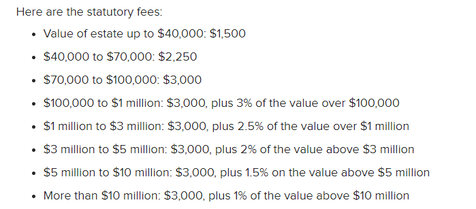 These fees are only for “ordinary” services. Anything the lawyer does that isn’t ordinary—for example, handling a will contest or giving tax advice—is presumed to justify a larger fee. If a lawyer follows the fee schedule, the fee may be almost unrelated to the amount of legal work done. It may be the same amount of work to handle a $1 million brokerage account as it is to probate a $100,000 account—but under the statutory fee schedule, the bill for the million-dollar account would be ten times larger. Now you may be ready after reading this to immediately go “those dirty rotten attorneys” and quite frankly this article is not intended to denigrate our estate attorney friends. It is to merely point out that this process can be expensive and like much in life, a little advanced planning goes a long way. Here are few things you can do in advance to lower that cost: 1) Establish Your Beneficiaries The simple answer to this issue is to make sure every asset you own that can have a beneficiary designation has one. This includes every retirement account such as 401(k)s, 403(b)s, IRAs and even your life insurance policies. Be sure to name both a primary and contingent beneficiary in case you and your primary beneficiary would to perish at the same time. 2) Joint Ownership for Some Property The next not so simple answer is to consider how your taxable accounts and assets are titled. For example, if you own a home and many Americans do, consider holding it in joint tenancy with the right of survivorship with your partners. If you live in a state, such as Florida, that allows tenancy by entireties for married couples, consider holding the title to the home or vacation house as tenants by entirety. 3) Pay-On-Death or Transfer-On-Death Designations If you own a bank or investment account, it is now possible to designate someone as a beneficiary on many of these accounts. This is called either Pay-On-Death (POD) or Transfer-On-Death (TOD). Unlike some joint ownership structures, the POD or TOD beneficiary has no rights to this property while you are still alive. 4) Fund that Trust How about those ownership interests in businesses, partnerships or other investments where there are no POD or TOD options? Ideally these assets are titled in the name of your revocable trust. You know revocable trusts are not just for the affluent. They can be a viable option for anyone! Let me give you a recent example from one of our families. We recently started working with a new family with a successful medical practice. When we started looking at her ownership interests in various entities, we noticed that they were all in her name personally. When we sat down with her and explained that her $12.1 million in entity values would have to go through probate on her demise she seemed disinterested. We then explained that these assets would be in the public record at her demise, she perked up a little. However, she figured she would be gone anyways and who cares what the public knows at that point. However, when we explained that these assets would cost her estate an estimated $215,000 in legal fees based on the statutory schedules above as part of the estate process in Florida, that is when she fell off her chair. The solution is a simple assignment agreement for each of her 20 entities and probably less than $5,000 in legal fees today. Would you rather pay $5,000 today to save your heirs $210,000 tomorrow? I think just about anyone would. However, the truth is the most neglected step in the estate process for the affluent is the retitling of assets, called funding the trust. Conclusion The moral of the story today is a little advanced work, can save your heirs a lot of headache and your estate money in legal fees.  It is a little like the old FRAM oil filter commercials, “You can pay me now or you can pay me later.” The same concept applies here, except the bill down the road could be much larger.
A word of caution, although it is easy to implement some of the ideas, above, to reduce legal fees in the probate process, there are many pros and cons to blindly relying on beneficiary designations, joint ownership, and POD designations. It is recommended you always seek the help of a qualified attorney in this process. Let us know how we can help. |
© 2026 InTrust Advisors, Inc. All Rights Reserved
This site is designed for U.S. residents only. The services offered within this site are available exclusively through our U.S. financial advisors. InTrust Advisors U.S. financial advisors may only conduct business with residents of the states for which they are properly registered. Please note that not all of the investments and services mentioned are available in every state.
CONTACT US | PRIVACY POLICY | DISCLOSURES | VIEW OUR FORM ADV 2 A & B | VIEW OUR FORM CRS | INTRUST FAQ
TAMPA, FLORIDA / PHONE: 813.253.2388
EMAIL: [email protected]
This site is designed for U.S. residents only. The services offered within this site are available exclusively through our U.S. financial advisors. InTrust Advisors U.S. financial advisors may only conduct business with residents of the states for which they are properly registered. Please note that not all of the investments and services mentioned are available in every state.
CONTACT US | PRIVACY POLICY | DISCLOSURES | VIEW OUR FORM ADV 2 A & B | VIEW OUR FORM CRS | INTRUST FAQ
TAMPA, FLORIDA / PHONE: 813.253.2388
EMAIL: [email protected]